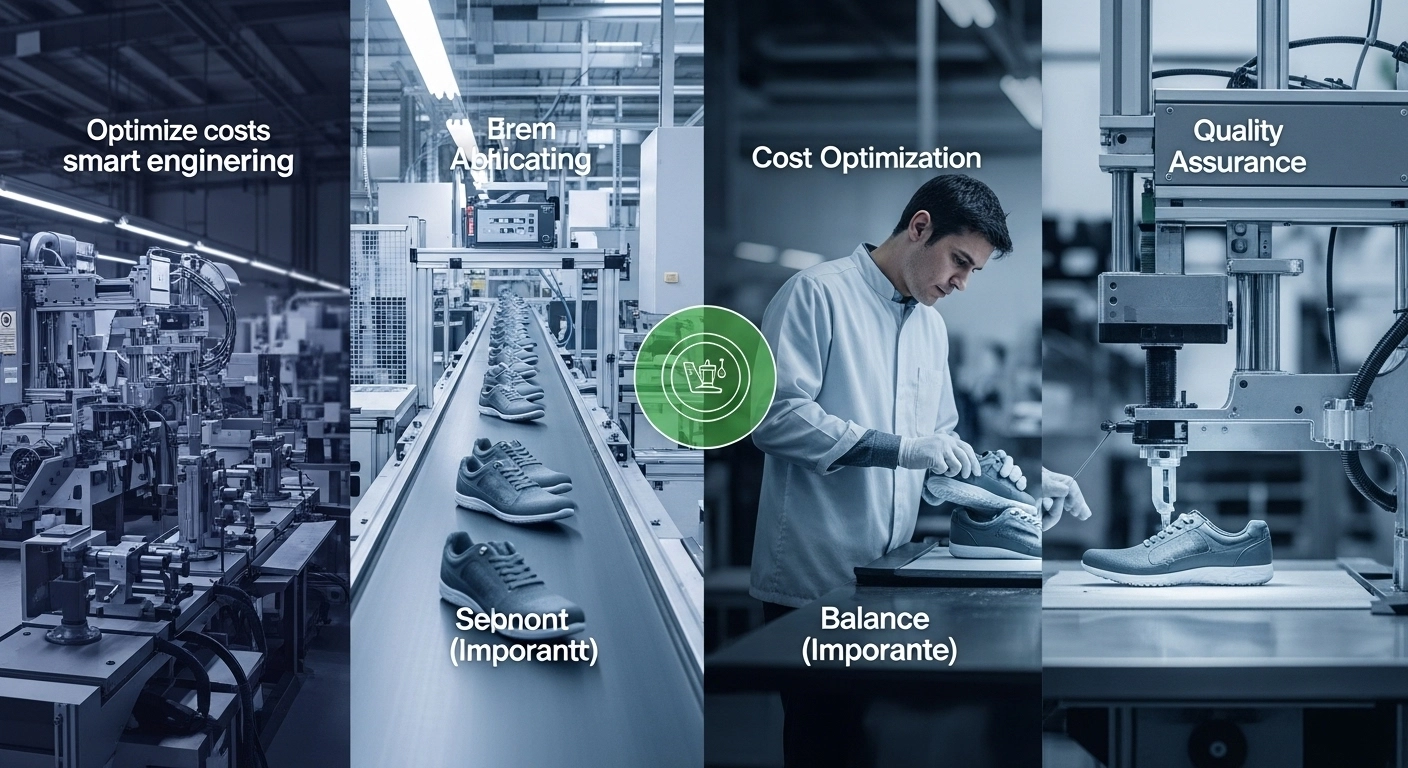
Raw production cost is natively the single most dominating factor determining your ultimate profit margin in global footwear manufacturing. In a hostile market where wholesale retail prices operate under relentless pressure from e-commerce compression, the absolutely only proven vector to protect your margins is to aggressively drive systemic costs down directly from the factory floor up. DCC's lead consultants have historically engineered and delivered massive 10–20% physical cost savings per unit across multiple top-tier Indian firmware manufacturers. Here are the 10 most brutally effective strategies we deploy.
The 10 Engineered Cost Reduction Strategies
Most massive factories blindly rely on standard off-the-shelf compound recipes. An engineered custom formulation optimised exclusively for your product drops raw material cost by 5–12% while boosting performance properties. DCC engineers develop cost-reduced EVA and TPR formulations meeting brutal BIS standards.
A minor 5% rejection rate on a 1,000 unit daily run costs you roughly ₹2,500–₹10,000 in compound waste daily. By standardising injection temperatures, compressing cycle times, and locking in quality checkpoints, your rejection rate effectively halves within a strict 60-day operational margin.
Traditional thermal cemented constructions demand massively expensive quantities of PU adhesive, chemical primers, and volatile activators. Utilizing direct vulcanisation (DV) or direct injection systems deletes complex adhesive costs outright and severely cuts physical assembly labour dependency.
Countless mid-tier manufacturers source volume chemicals from small local distributors at heavy markups. Aggressively consolidating chemical procurement through a master procurement consultant like DCC forces manufacturer-direct contract pricing, natively saving 8–15% across raw compound volumes.
Lighter soles inherently consume less bulk volume. Engineering a mere 10% reduction in sole compound weight dynamically saves essentially 50–80 kg of compound capital daily on a typical 1000 pair run. DCC executes this through micro-filler optimisation engineering.
Polymer moulding machines are notoriously energy-intensive. Executing simple algorithms—stabilizing intense barrel temperature heat profiles, killing idle cycle heating times, and rapidly implementing mould cool-water circulation—cuts the direct energy cost per unit by nearly 15%.
The Lean Matrix specifically targets 8 massive waste categories: physical overproduction, idle waiting, transit, excessive processing, dead inventory, unnecessary motion, defective waste, and squandered worker talent. Integrating this framework historically isolates massive capital recovery.
Several domestic Indian factories consistently import general components like steel buckles, eyelets, and standard foam insoles directly from China when brutally identical alternatives physically exist locally. Switching this network totally deletes the massive hidden costs of 60-day slow-freight timelines.
Complex variance is profoundly expensive. Each unique product size, random colour variant, or custom exterior material severely bloats stagnant inventory and machine changeover latency. Eliminating the bottom 20% of dead SKUs creates an instant 15% surge in mechanical efficiency.
Shockingly, most volume factories never mathematically track exact active unit costs—they broadly estimate it. Injecting live cost-mapping metrics over material output, worker labor, and energy drag enables brutal cost-reduction precision. DCC provides custom tracking systems immediately.
FAQs — Factory Cost Reduction Execution
Rapid technical interventions focusing strictly on primary chemical formulation and batch rejection rate termination authentically manifest massive visible mathematical results entirely within 30 to 60 operational days. Deeper structural shifts natively addressing core industrial process redesign dynamically record massive total impact curves crossing the 90–180 day timeline.
Ready to severely drop your factory production costs?
Cease gambling massive capital on unverified output rates. Partner with India's most aggressive industrial cost-reduction team.
Implement Immediate Cost Reductions