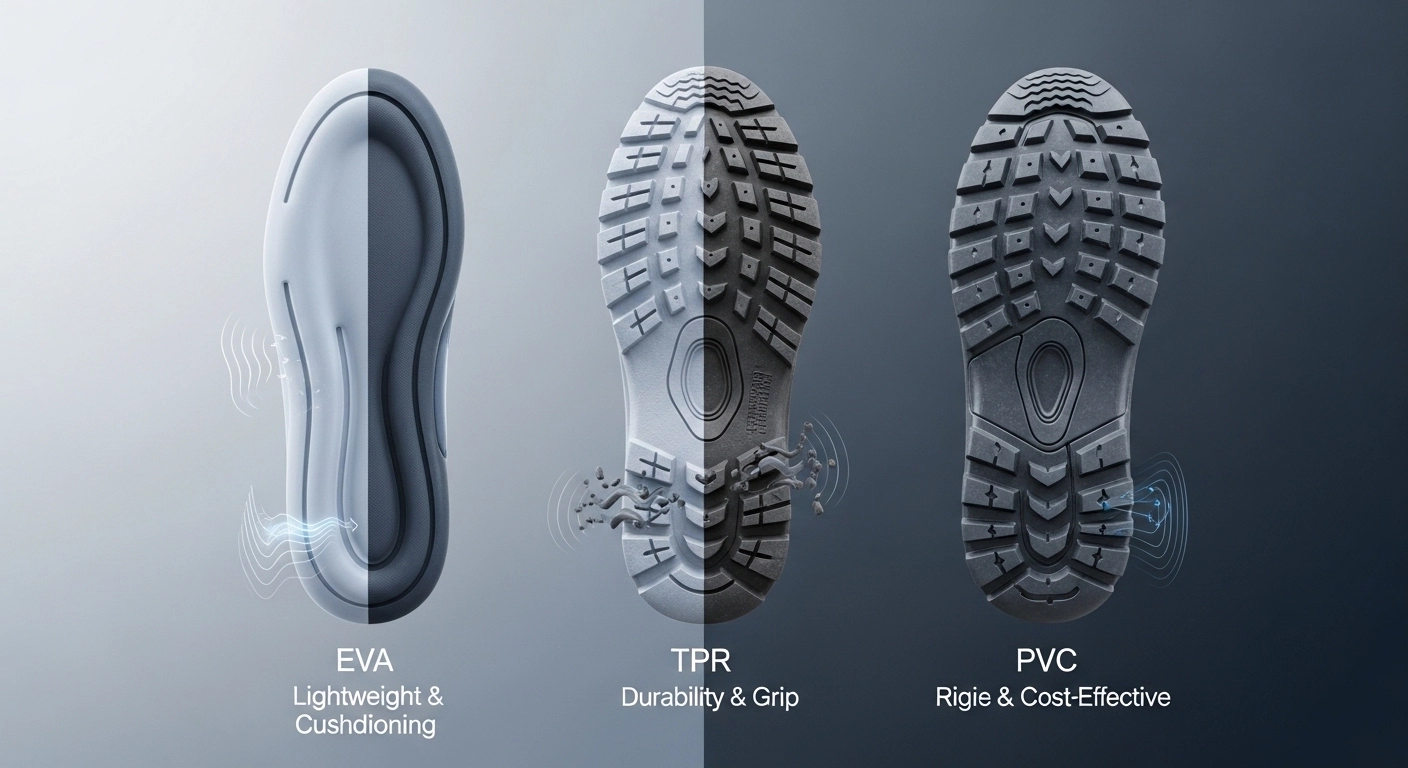
If you are a footwear manufacturer trying to decide between EVA, TPR, and PVC for your next sole compound, you are facing one of the most consequential material decisions in the industry. The wrong choice can inflate your production costs, compromise durability, or make your product fail market tests. In this guide, DCC's chemical engineering experts break down each material so you can make an informed, ROI-positive decision.
What Is EVA (Ethylene Vinyl Acetate) in Footwear?
EVA, or Ethylene Vinyl Acetate, is a lightweight, flexible foam material widely used in midsoles and outsoles. It is the preferred material for sports shoes, casual footwear, and children's shoes because of its excellent shock absorption and low density. EVA soles are produced efficiently through precise injection moulding or compression moulding processes.
Key Properties of EVA
- Density: 0.15–0.25 g/cm³ (Extremely lightweight)
- Shore Hardness: 25–65 C (Soft to medium formulation)
- Excellent cushioning and shock absorption
- High chemical resistance
- Recyclable and environmentally friendly
Best Use Cases for EVA
- Sports and high-performance athletic footwear midsoles
- Children's school shoes requiring lightweight structure
- Slippers, flip-flops, and injected sliders
- Lightweight casual sneakers
What Is TPR (Thermoplastic Rubber) in Footwear?
TPR, or Thermoplastic Rubber, seamlessly combines the processing ease of thermoplastics with the functional, grippy properties of rubber. It is heavily utilized for outsoles in formal shoes, sandals, and heavy-duty school shoes because of its intense durability, superior ground grip, and extreme cost-effectiveness. TPR compounds can be expertly tailored to meet specific hardness and vivid colour requirements.
Key Properties of TPR
- Density: 0.9–1.2 g/cm³ (Heavier and denser than EVA)
- Shore Hardness: 50–90 A
- Extreme abrasion and scuff resistance
- Excellent flexibility even at freezing temperatures
- Easy to colour, mould, and texturize
Best Use Cases for TPR
- Formal and semi-formal shoe outsoles requiring rigid grips
- Heavy-duty school and lightweight safety footwear
- Sandals and low-cost casual shoes
- Export market footwear where international durability standards are critical
What Is PVC (Polyvinyl Chloride) in Footwear?
PVC (Polyvinyl Chloride) is one of the most widely used industrial polymers on the globe. In footwear manufacturing, it finds extensive application in injection-moulded shoes, functional rainwear, and mass-market low-cost sandals. While PVC is remarkably heavier and stiffer than both EVA and TPR, it is the most affordable raw option available and guarantees absolute water resistance.
Key Properties of PVC
- Density: 1.1–1.4 g/cm³
- Shore Hardness: 55–85 A (Highly dependent on the specific chemical formulation)
- Absolute water and chemical resistance barrier
- Low material cost — representing the most affordable bulk option
- Versatile aesthetics; can be formulated transparent or opaque
Best Use Cases for PVC
- Injection-moulded rain boots and completely waterproof footwear
- High-volume, low-cost daily-wear sandals
- Fashion footwear requiring high-gloss or transparent finishes
- Industrial protective and safety boots
Head-to-Head Comparison: EVA vs TPR vs PVC
When engineering your plant's production run, here is a rapid comparison hierarchy to guide your raw material selection decision:
- Weight: EVA (Lightest) > TPR > PVC (Heaviest)
- Cost & Capital: PVC (Cheapest) < TPR < EVA (Highest cost per kg, but significantly higher volume yield due to weight)
- Tensile Durability: TPR > PVC > EVA
- Comfort & Cushioning: EVA > TPR > PVC
- Environmental Sustainability: EVA (Highly recyclable) | TPR (Partially recyclable) | PVC (Challenging to recycle natively)
- Manufacturing Complexity: PVC (Easiest) | EVA (Moderate/Requires precision) | TPR (Moderate)
How DCC Helps You Choose the Right Material
At Dixit Chemical and Consultation, our chemical methodology goes beyond basic supply. Our engineers analyse your target market segment, factory production capacity, specific cost budget, and export quality benchmarks before recommending a formulation strategy. We have successfully designed custom EVA, TPR, and PVC compounds for massive brands including Bata, Action, and Red Tape. Our formulation service guarantees that your plant produces the ideal compound—optimised for lowest cost, maximum performance, and premium brand positioning.
FAQs — EVA, TPR, and PVC in Footwear
TPR generally offers the best abrasion resistance and ground-contact longevity for outsoles. This intense structural integrity makes it the ideal formulation for school shoes and everyday formal wear where sheer durability is the absolute top priority.
EVA—or a hybrid combination of an EVA soft midsole paired with a hard rubber outsole—is the gold standard for athletic footwear. Global leaders like Nike, Adidas, and premier Indian brands such as HRX entirely rely on EVA-based foam midsole compounds.
Absolutely. This is a highly strategic and incredibly common manufacturing construction: utilizing an EVA midsole for lightweight cushioning, layered on a TPR outsole for heavy-duty grip and durability. DCC specialises in engineering exactly these advanced hybrid sole constructions.
Ready to transform your production output?
Stop relying on trial-and-error chemistry. Let India's premier chemical engineers formulate your success.
Book Technical Consultation